4.02.2010

This post canceled, due to sunshine

photo

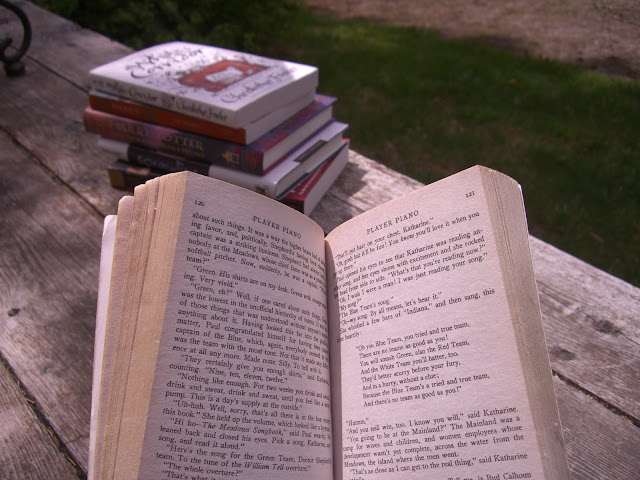
On a day like today, I hope you've all had a chance (or are on your way) to get out of doors! Go ahead--give your skin some fresh air, maybe even run around barefoot for a little while.

Have a great weekend!

3.26.2010

Three reviews

March, and often into April, seem to me especially good months for reading. It's a transitional time when winter's fading but the really lovely, warm spring weather hasn't arrived (except in a teasing "soon, but not yet" sort of way). I like to hunker down with a stack of books until green things start poking through last year's dead grass and the last of the snowbanks have finally disappeared from the yard--total escapism.

This week, we're each going to share one book that has kept us occupied (and sane) this season.

Linda:

I Thought You Were Dead by Pete Nelson (Find it on our Staff Picks table now!)


Talking dog? I had my doubts. But in the same way that I want a reader to take a risk--say when I am trying to sell them a book about sheep farmers in Iceland--I figured I owed it to this book to give it a try. In short, the relationship between Paul and his dog Stella is the best relationship between any characters--human, canine, feline, bovine--anything or anyone in fiction, and probably in life. I'd welcome Paul and Stella on my doorstep any day, and in the meantime I'll be so happy I met them while I was reading.

Sandy:

Will Grayson, Will Grayson by John Green and David Levithan (available April 6)


I love this collaboration between David Levithan and John Green.  It's the story of two boys named Will Grayson who live in different suburbs of Chicago. One Will Grayson lives by rules that will keep him out of the spotlight, number one of which is "Shut up." Unfortunately for him, it's hard to avoid the spotlight when your best friend is Tiny Cooper, "world's largest person who is really, really gay."  The other Will Grayson faces a daily battle with depression and finds his only solace in online meetings with a guy named Isaac. One night, the Will Graysons' paths cross, and each boy finds his life changed in ways he wouldn't have imagined. Engaging from the first page, the story is funny, heartbreaking, redemptive, and completely captures the frustration of those teenage years when you're trying so hard to understand who you are and how to deal with life's highs and lows. (Not to say that ends as soon as the teen years are over.)


Stella:

My Name is Mary Sutter by Robin Oliveira (available May 13)

Robin Oliveira's debut novel is a Civil War story full of wonderful historical detail and strong writing. Mary Sutter is a woman who wants to become a surgeon, succeeds, and discovers her strengths and limitations along the way.  The book is loosely based on the life of Mary Edwards Walker, the first American female surgeon and the first woman to receive the Congressional Medal of Honor. [edited 3/29: Though some aspects of the character's life might be similar to that of Mary Edwards Walker and other female surgeons of the Civil War, the author would like to note that Mary Sutter is a completely fictional character.]
(I really enjoyed this book, but if you have a weak stomach there are some graphic descriptions of battlefield wounds and amputations that you might want to skip past.)

3.05.2010

Guest Blogger: Ben Hewitt

Ben HewittThis week, thanks to Cabot author Ben Hewitt for contributing. Ben will be launching his new book, The Town That Food Saved: How One Community Found Vitality in Local Food, at The Galaxy Bookshop on Tuesday, March 16, at 7 p.m.
When Linda and Sandy asked me to write a post on the upcoming launch
of my book, The Town That Food Saved, I almost said no. After all, I’d just written 70-something thousand words on the Hardwick area; I figured I’d stuck foot (pen?) firmly in mouth plenty of times, already. And then, ever the glutton, I decided what the hell: A time or two more can’t hurt.

I spent about a year writing this book. The process was by turns
exciting, dispiriting, confusing, and affirming. I’d naively sold the
book on a simple premise: That Hardwick needed saving, and that a
localized food system was just the thing to make it so. It didn’t take
long to determine that it would be vastly more complicated than that,
and the book began to turn on my struggle to understand these
unanticipated complexities. I’d say more, but of course then you
wouldn’t need to buy the book.

In the weeks following this launch, I’ll be spending a lot of time
talking about the book (and by extension, Hardwick) in communities
throughout the northeast. The degree of interest has far exceeded my
wildest expectations, and it feels incredibly important that I carry
with me the news of Hardwick, particularly as it relates to the
region’s evolving food system. I want to know how you feel about the
goings-on about town, the boom in food-based enterprises, and the
ensuing media coverage. Are you inspired? Disheartened? Or merely
indifferent? Is Hardwick really the town that food saved, or does it
need another agricultural enterprise like it needs a snowstorm in
September? (To be sure, both will probably happen)

So I invite you to come to the Galaxy Bookshop on the evening of March
16. I’ll read a little; I’ll probably talk a little too. But mostly, I’ll be there to listen.

* * * * * * * * * * * * * * * * * * * * * *

The Town That Food Saved is already receiving praise from reviewers around the country:

Times Argus

Publisher's Weekly (seventh title down)

School Library Journal (about two-thirds of the way down the page)

Los Angeles Times

3.03.2010

Walking to Gatlinburg: A Recap

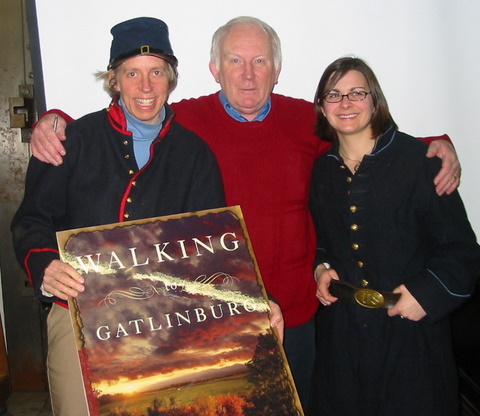
Linda, Howard and SandyWhat a great way to start off our 2010 Reading Series! Howard Frank Mosher launched his nationwide book tour (which will include stops in somewhere between 60 and 100 cities across the country) at The Galaxy Bookshop last night. While we had some of the typical pre-event jitters (Will the books show up? They did--at 2:00 yesterday afternoon. Will anyone come? Most certainly--a standing-room-only crowd!) any fears we had were laid to rest as we welcomed Howard and his audience to the store.


Our friend Will--who, among other things is a Civil War reenactor--loaned Linda and I the fabulous period coats we're wearing in the photo above. We received a huge round of applause and laughter when we made our entrance. I think Howard got a huge kick out of this, too, since we decided to surprise him and not put on our costumes till the last minute.

Howard used to be known as a fairly quiet author, and one who never read from his books, but last night he spent an hour entertaining us with stories about his writing career and the work that went into writing Walking to Gatlinburg and read not one but two sections from the novel. One of our customers, hugging her new book to her chest, told me that she thought that no one would get much sleep that night, because they'd all be up, racing through their books!

After he'd signed several dozen books (including extra stock, which is available now), Howard, his lovely wife, the booksellers, and a few guests including contest winner Charlie, went to Claire's Restaurant to celebrate a very successful and enjoyable evening.

Thank you so much to everyone who joined us for this memorable event!

* * * * * * * * * * * * * * * * * * * * * * * * * * * * * * *

Local and national praise for Walking to Gatlinburg.

2.18.2010

Why I Always Launch My Book Tours at The Galaxy Bookshop

author photoSpecial thanks to this week's guest blogger, Howard Frank Mosher!

On Tuesday, March 2, at 7:00, the Galaxy Bookshop will be hosting the WORLD PREMIER of my new Civil War novel. Walking to Gatlinburg tells the story of 17-year-old Morgan Kinneson, who walks from Kingdom County, Vermont, to Gatlinburg, in the Great Smoky Mountains, in search of his brother Pilgrim, a non-combatant Union surgeon missing in action.

For years, I’ve started my book tours at the Galaxy. Independent bookstores are the best booksellers, and the Galaxy represents everything that’s wonderful about them. Chain bookstores tend to all look alike, but indies are all different. The Galaxy, for instance, was once a bank. It still has a vault, not to mention the only drive-by window of any bookshop in the – well, galaxy.

When I walk into a great independent bookstore like the Galaxy, I immediately jacket imagesense that I’m surrounded by all my best old (and new) friends: Robert Frost, Jane Austen, Ernest Hemingway, Charles Dickens, Richard Russo, the Northeast Kingdom’s Leland Kinsey and David Budbill.

At my Galaxy events, most of the people are my friends. They’re from the Kingdom. When I show my signature slide of myself shooting a bad review with my shotgun, they nod gravely as if to say, “What else would you do with an unfriendly review in the Times?”

Most important of all, I launch my books at the Galaxy for the same reason I buy all my books there. Like independent booksellers from coast to coast, Linda and Sandy and their staff know and love books the way this clueless storyteller knows and loves the outlaws, living and deceased, of the Northeast Kingdom. Why would I ever buy a book any place else?

Please come to the Galaxy and meet Morgan Kinneson and some of his fellow outlaws from Walking to Gatlinburg on March 2 at 7:00 when I’ll be talking about the new novel and my psychopathic, murderous great, great grandpa, who, I’m sorry to report, inspired the mad villain Ludi Too in my latest! Sad but true. See you at the World Premier.

2.12.2010

Happy Valentine's Day

Valentine's Day gets a bad rap. It's overhyped by card companies and can feel like a kick it the teeth when you're single. Even when you're in a happy relationship, it can feel like there's a lot of pressure to make the perfect romantic gesture for your loved one (see "overhyped by card companies" above).
I say, let's celebrate all kinds of love on Valentine's Day. Let's celebrate our  love of our community; our wonderful pets, best friends, and dear family members; our favorite books and authors.

Happy Valentine's Day, with love from all of us at The Galaxy Bookshop!

2.05.2010

Macmillan: Hero or Villain?

The title of this post is, for me, a rhetorical question. Despite Amazon and many of its customers crying foul over Macmillan's refusal to meet Amazon's terms on lowering the prices of its e-books, as both a bookseller and a member of a democratic and capitalist society, I am thrilled that Macmillan has stood firm on its pricing policy. Macmillan's stand paves the way for other publishers to do the same, and to assert control over their products and services--something Amazon has been trying to take for themselves in subtle and overt ways.

I've discussed the issue in the past, and during this week, with people outside the bookselling world, and their thinking is often along the lines of, "Well, publishers make plenty of money--they're just being greedy;" and on the subject of Amazon ceasing to sell all Macmillan titles since Friday, "That's Amazon's perogative." The second comment is certainly true--Amazon can choose to sell or not sell any products it wishes. Despite this particular move coming off as a bit of a temper tantrum to some, that fact remains. As for the first comment, the concrete numbers of publishing profits continue to elude me. I am not going to argue one way or the other on that issue--or on the issue of the value of good literature.

For what it's worth, here is my take on the matter.  This conflict with Macmillan (and any other publishers that come to their senses) is all about the online retailer trying to bully publishers into doing business Amazon's way. Amazon is a huge company that, for many publishers, is their biggest account, and this gives the company a huge amount of leverage in any negotiations. At least, that's how it's been up to this point. After all, this isn't the first time Amazon has tried strong-arming a publisher by ceasing to sell its books (perhaps one of Hachette's motivations in joining Macmillan's side in the e-book price war).

However, as The Amazon Kindle Team so misleadingly put it in their "poor us, trying to stick up for the little guy" * letter to customers, publishers do, indeed, have a "monopoly" over their books. That is, if you define "monopoly" as one company owning the rights to the products that it produces and sells. I think most of us would agree that, while the vocabulary might be correct in a literal sense, it in no way corresponds to the typical use of the word.

Macmillan and other publishers need to finally realize that, yes, they do own the books that they sell, and that means that they get to have the final say in how they price and distribute those books. I'm not suggesting that all of the publishers join together in setting prices for their books--that would be getting into monopoly territory, and very illegal--but they each need to determine the appropriate value of their books, in physical or digital format, that will sustain both the publishing house and the larger industry long into the future. If the publishers don't assert themselves now, it will only get harder down the road, and they may find themselves out of business after allowing Amazon to drive them down to unsustainable prices while driving the publisher's other customers (i.e. your friendly neighborhood booksellers) out of business.

More links:

Macmillan's jab at Amazon, in a New York Times ad

Macmillan's latest comment

It's important to remember the other injured party here: the authors whose works are being made unavailable by Amazon. Of course, this works to the advantage of other booksellers (Indiebound!) when authors choose to link to Amazon's competitors.

Author John Scalzi (a Macmillan author) has had a lot to say on the subject

A really wonderful post by a fellow New England bookseller

I'd love to hear from you on this--thoughts, questions, debate. What's your take? Do you feel this affects you one way or another...or not at all?

*Sorry, I don't buy it. It was Amazon's choice to take a loss on e-book sales by pricing them below wholesale. By demanding that publishers make $9.99 (or less) the standard retail price, Amazon is trying to save face with their customers and start making a profit on sales again.